Home » Resource hub » What are our shared resources?
This resource prompts us to think about different skills and resources that we have, and those that we might need from others, in order to thrive in a climate-changing world. It gets us to ask both – “what can I offer?” and “what do I need from others?” Looking through the lens of community, learners will have the chance to think about the relationship between dependance and interdependence and consider both the things community can offer, and where it might fall short. It includes an opportunity for a practical mapping of assets and skills for learners to assess what it is they have to offer, and what gaps might be needed to be filled by others.
Read the following for context:
Learning about climate change and its impact on the way we live now and in the future can often feel overwhelming and disempowering. More severe weather events, once habitable places becoming uninhabitable, disruptions to our food and energy systems - all of this can bring up feelings of fear and scarcity, and it is natural for a certain tension to arise between acting in the best interest of yourself and your innermost circle – being entirely independent - and supporting and being part of the wider community – interdependent.
Facilitator prompts the group:
Let’s begin by brainstorming what type of skills, knowledge, and physical resources may be useful or even essential to our community in the context of a climate changing world.
Read for context:
Jewish tradition has a lot of wisdom and insight to inform how we design our communities and our social structures, and one theme that is consistent throughout is that we must ensure that the needs of all people, especially the most vulnerable, are met. We learn through the vast laws of Tzedakah that in times of social and economic challenges, it is through community ties and shared resources that we can collectively thrive.
Community, while an intangible idea, is something that we feel and experience on a consistent basis. It signifies a group of people who follow a particular way of life or patterns of behavior which bind them. Community often rests upon shared values, constructs and – as we will see in our exploration below – both tangible and intangible resources.
Facilitator prompts the group:
A "GEMACH":
Facilitator reads the following:
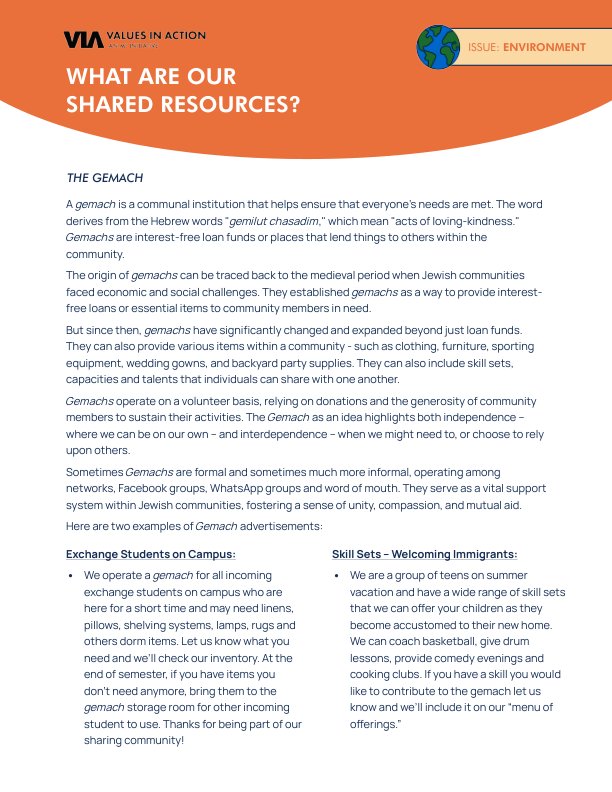
Using the Jewish concept of "a gemach" can help deepen our understanding of shared resources within a community. A Gemach is a communal institution that helps ensure that everyone’s needs are met. The word derives from the Hebrew words "gemilut chasadim," which mean "acts of loving-kindness." Gemachs are interest-free loan funds or places that lend things to others within the community.
| Scan the QR code or use this handout to learn more about the concept of the Gemach. Have participants in pairs read this for background and context, then consider the prompts below: |  |
Facilitator chooses 2-3 questions from the following list to guide a discussion:
Facilitator prompts the group:
Before we engage in the activity below, think back to the Covid-19 pandemic as a way of testing what you learned about your independence v. your interdependence.
Asset Mapping:
Let’s connect the discussion above back to the specifics of climate change:
Facilitator prompts the group to debrief:
Facilitator reads:
Now that we’ve had a chance to learn about the gemach and reflect on our own resources, we can put this new knowledge into action and begin to build more mutual support networks within our communities.
Facilitator prompts the group:
Through this exercise, we’ve explored the questions that naturally arise for people in moments of crisis - how should I spend my limited time, energy, and resources, and who should I prioritize helping? What even are the things that I am fully equipped to do – places where I am independent – and where do I need others – where am I interdependent? We’ve looked to the Jewish practice of the gemach as a model for mutual aid and community resourcefulness, and we’ve reflected on the skills, knowledge, and resources that we as individuals may be able to offer the wider community. Confronting the climate crisis has many different components and can often feel overwhelming and disempowering. Through this activity, we hope you have gained more insight into what assets you are carrying with you and can share, and how you can and will likely need to rely on others within your community as well.
Facilitator prompts the group:
Through this exercise, we’ve explored the questions that naturally arise for people in moments of crisis – how should I spend my limited time, energy, and resources, and who should I prioritize helping? What even are the things that I am fully equipped to do – places where I am independent – and where do I need others – where am I interdependent? We’ve looked to the Jewish practice of the gemach as a model for mutual aid and community resourcefulness, and we’ve reflected on the skills, knowledge, and resources that we as individuals may be able to offer the wider community. Confronting the climate crisis has many different components and can often feel overwhelming and disempowering. Through this activity, we hope you have gained more insight into what assets you are carrying with you and can share, and how you can and will likely need to rely on others within your community as well.
Facilitator prompts the group: