Home » Resource hub » Should I Do Things that Scare Me?
At-a-Glance:
The word “awesome” is used to describe everything from shoes to new technology. But do we ever use it to describe something that evokes actual awe? And what is awe anyway? This resource explores awe through an interactive scavenger hunt following a text study by Rabbi Abraham Joshua Heschel about the connection between awe and fear. In a world that can feel monotonous and routine, exploring awe can provide us with an opportunity to think and feel beyond ourselves.
We have all heard the word, “awesome” used in casual conversation. Maybe you use it all the time or you are sick of hearing other people use it. Whatever your thoughts on the word, have you ever stopped to think about what it actually means?
Facilitator prompts group:
Awesome contains the root, awe. But when do we ever use it to describe actual awe? Dr. Dacher Keltner is a scientist at University of California Berkeley and a pioneer of the study of awe. He has identified that seeking awe in your everyday life is an antidote to unhappiness. Keltner defines awe as, “the feeling of being in the presence of something vast that transcends your current understanding of the world.” (from Awe: The New Science of Everyday Wonder and How It Can Transform Your Life)
In Hebrew the word for Awe, yirah יראה, also means fear. In Hebrew when two words have a shared meaning or a root, it is often worth paying attention!
Abraham Joshua Heshel is one of the major modern thought leader rabbis about awe. He wanted people to live with radical amazement, seeing every moment as the awe-inspiring gift it is. We are going to look at quote from his book, God in Search of Man.
Facilitator prompts group to study the following text in groups of 3 for about 8 minutes:
"Fear is the anticipation and expectation of evil or pain, as contrasted with hope which is the anticipation of good. Awe, on the other hand, is the sense of wonder and humility inspired by the sublime or felt in the presence of mystery…Awe, unlike fear, does not make us shrink from the awe-inspiring object, but on the contrary, draws us near to it. This is why awe is compatible with both love and joy. In a sense, awe is the antithesis of fear.”
- Abraham Joshua Heschel, God in Search of Man, page 77
There is such an awesome buzz of conversation in this room. Will you choose one person to share a highlight from your conversation?
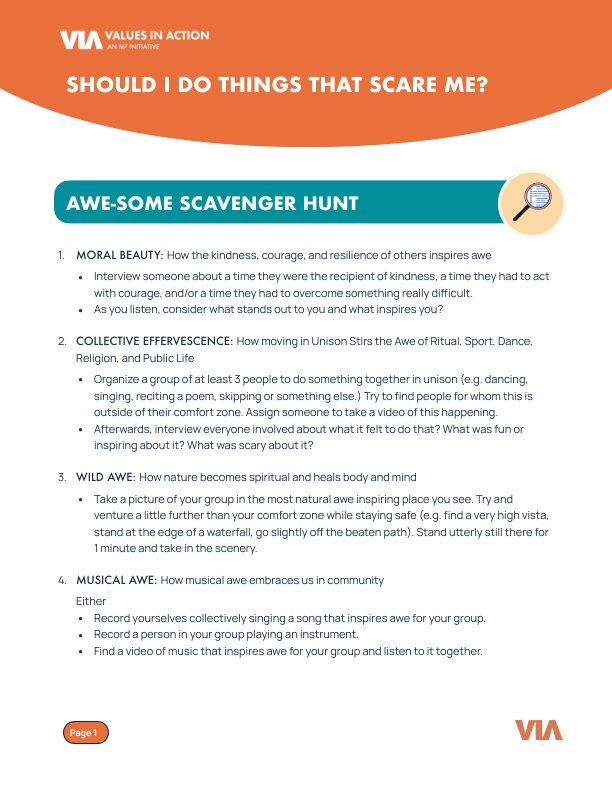
In the research on awe, Dr. Keltner says to pay attention to moments of Whoas, Chills and Tears as some biological signs that one is experiencing awe. He lays out 8 categories of finding awe which we are going to explore together over the next 30 minutes through a scavenger hunt! You will be working with your small group to explore as many Dr. Keltner’s categories of awe as you have time for. Let your feelings guide you as to when it is time to move onto the next. Quality is more important than quantity in this experience.
Note to facilitator: Before you start the activity, decide on a time and place the groups should reconvene.
1. MORAL BEAUTY: How the kindness, courage, and resilience of others inspires awe
2. COLLECTIVE EFFERVESCENCE: How moving in Unison Stirs the Awe of Ritual, Sport, Dance, Religion, and Public Life
3. WILD AWE: How nature becomes spiritual and heals body and mind
4. MUSICAL AWE: How musical awe embraces us in community
Either
5. SACRED GEOMETRIES: How our awe for visual design helps us understand the wonders and horrors of life
6. THE FUNDAMENTAL “IT”: How spiritual life grows out of awe
7. LIFE AND DEATH: How connecting to our mortality makes us feel alive
8. EPIPHANY: We are part of systems larger than ourselves
Welcome back! I would love to hear at least one highlight from each group about what they experienced.
Facilitator prompts group:
Wow. I am inspired. Thank you. May we all have a week ahead that is filled with a little more awe, inspiration, joy, and connection.