This resource raises the tension of how to address growing populations’ need for housing, while taking into account climate change and the desire to preserve our natural resources. It presses learners to think broadly about innovation as it plays out in their lives. It draws upon Biblical texts and invites learners to explore Jewish artistic imagery. By focusing the issue within our communities and engaging with it from the perspective of zoning boards and land use committees, learners understand how these decisions impact their daily lives and are not just theoretical or physically far away.
Facilitator reads the following to provide context:
It is election season. In a local city council race there are two candidates. One is advocating for building 25,000 units of housing on 500 acres of current farmland and forest (it abuts another 4500 acres of undeveloped private land). The other is advocating for preserving more natural space. Putting other pressing political issues aside, which candidate would you support?
Facilitator prompts the group to consider the following questions:
Facilitator reads for context:
The scenario presented above presses us to think about how we balance growing housing needs with environmental considerations, and more generally gets us to think about the value of innovation as it plays out in our lives. Innovation is the value that allows us to offer fresh perspectives on what already exists. It enables growth and change. But how does change sit alongside the value of preservation that we hold? How can we at once create – making the world a better and more interesting place as we do and at the same time preserve that which is already good? These are big questions that impact both day to day and long-term decision making and planning.
Facilitator prompts the group:
Facilitator explains the activity by reading the following out loud:
In the handout you are about to receive, there is a list of attributes that many people would say a family/community should have. But it is not possible to have all of the items, because resources are limited and life involves making tough choices. Many of them ask us to consider the value of innovation as it impacts preservation.
For this activity, find a partner and together assign a rating to each of the items on the hand-out according to the following metric:
You must make tough choices, and therefore, you may not give more than three statements “Must Have” status (an A+++ rating).
Facilitator gives participants 10 minutes to work on their hand-outs in pairs.
Facilitator brings the group back together as a whole.
Facilitator opens up for group discussion:
Facilitator reads for context:
As we think about this complex decision-making, Jewish sources can offer insights for how we might approach these questions. Looking at the early passages in Tanakh, the Hebrew Bible, gives us context for considering how innovation and preservation are in tension with one another.
In the story of the creation of the world, we appear to have two different “mandates” given to people.
On the one hand, after creating the world, God tells the first humans “to be fruitful and multiply,” and “to fill the earth and subdue it” (Genesis 1:28). Ultimately, according to this perspective, humans are meant to be creative and innovative, to build, to go and to do.
In the next chapter, (Genesis 2:15), God empowers humans to “till and to tend” the world.
The assumption in these verses is that the world belongs to God, and humans' job is to take what we need from it while also nurturing it for the future.
Facilitator prompts the group:
| Facilitator will lead the group in an analysis of the following artistic image. Scan QR code or click here for the image. Then facilitator prompts the group: | ![]() |

This image was designed based on the verses we just mentioned.
Look at the image carefully and consider some of the questions below: [Facilitator should choose 3-4 questions from the list on the next page for analysis of the image].
Background information on the image and facilitation notes for the facilitator:
The image represents a tension:
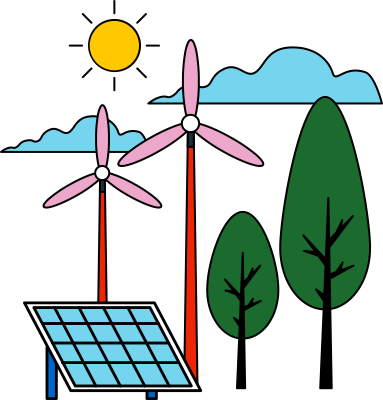
The right side of the image depicts scenes of our modern life and examples of how we use the world. The left side shows ways of interacting with nature as well as possible green energy sources, examples of preserving the world.
Our society cannot just live on the left. But what would our society look like (on the right) if we did not nurture the elements on the left? Even the modern world needs elements portrayed on the left of the image to survive and thrive.
If there is time, circle back with learners to their priorities on the hand-outs and ask them if they may change their priorities or some of their choices after looking at the image and the Jewish lens.

Facilitator brings participants back to the original presentation of the issue, by reading the following:
When discussing climate change and land use regulations, we sometimes see these as global issues where we have little control. We hear about a pipeline going through millions of acres of untouched forests, or the destruction of rainforests in a far off place to make room for more farmland. In our own communities, zoning boards and land use committees are making decisions that not only affect our own lives, but also impact the environment around us.
Facilitator prompts participants to action (depending on time, they can be instructed to do the research now, or, alternatively, the facilitator can encourage them to do it in the next few days):
What can we actually do to have an impact?
First, we can learn and find out how decisions are made locally about land use. Take out your phones and do a little research. After research is done, share some of your findings with the group.
1. Learn about zoning in your own community:
• Who is in charge of zoning in your community?
• What are the pressing issues your community is facing when it comes to zoning?
• How have zoning laws affected your life (if at all)?
2. We might be able to actively participate by making our voices be heard:
• Are zoning meetings open to the public?
• If so, we encourage you to attend a meeting, and if so moved, add your voice to the democratic process.
• How else might you be able to affect the local zoning process?
Facilitator reads the following to close for the group:
In the exploration we just experienced we faced a real tension between the immediate needs of a growing community and the longer-term impact on the environment; between the Biblical charge of humans to both conquer and preserve the world. There are no clear-cut answers to this tension, but engaging with the questions, forming positions and advocating action are our responsibilities as citizens who have inherited this world.
The Talmud (Taanit 23a) tells the story of Honi who came across a man planting a tree:
One day, as he was walking on the road, he saw a man planting a carob tree.
He asked him, "How long will it take this tree to bear fruit?"
The man replied, "Seventy years."
He asked, "Are you quite sure you will live another seventy years to eat its fruit?"
The man replied, "I myself found fully grown carob trees in the world; as my forebears planted for me, so am I planting for my children."
Facilitator prompts the group:
Facilitator reads the following to close for the group:
In the exploration we just experienced we faced a real tension between the immediate needs of a growing community and the longer-term impact on the environment; between the Biblical charge of humans to both conquer and preserve the world. There are no clear-cut answers to this tension, but engaging with the questions, forming positions and advocating action are our responsibilities as citizens who have inherited this world.
The Talmud (Taanit 23a) tells the story of Honi who came across a man planting a tree:
One day, as he was walking on the road, he saw a man planting a carob tree.
He asked him, “How long will it take this tree to bear fruit?”
The man replied, “Seventy years.”
He asked, “Are you quite sure you will live another seventy years to eat its fruit?”
The man replied, “I myself found fully grown carob trees in the world; as my forebears planted for me, so am I planting for my children.”
Facilitator prompts the group:
Pop Up that come after 2 clicks on page just for one time in coockes session