Home » Resource hub » How do we cultivate hope for all we can save?

 | This resource was created in partnership with Dayenu. |
This resource prompts us to think about how to remain hopeful in a climate-changing world. It draws on contemporary wisdom from author and activist Rebecca Solnit, who encourages us to think about what stands in the way of active hope. Through tactile and multi-media explorations of hope in the context of climate change, learners are invited to reflect on their feelings about climate change, the nature of hope and how to move forward when we find ourselves caught between what we imagine as “an ideal world” with what we see as “the real world.”
Note for facilitator:
If pairing with a service activity, considering pausing before the Take Action section and practice climate storytelling after your service work. Consider writing a kavanah or blessing about pragmatic hopeful action before engaging in service work.
Read the following for context:
The climate and ecological crisis is one of the greatest threats facing humanity today. How we engage with it, talk about it, and act in its wake shapes our present and will shape our future.
In the face of such a large-scale issue, we may hear people expressing that we are in need of hope.
Tikvah — hope, in its most active sense, is the ability to trust that, through action, a more just, livable world may yet come. In the context of climate change, active hope is a necessary and strategic practice that can help counter feelings of helplessness and despair. The difference between the worst outcomes and the best ones are huge and we can help make those better outcomes possible, but there are times when the issue can feel too overwhelming or scary to even think about, let alone know what to do about it. How do we balance what might be our natural inclination towards hopelessness at what we see before (the reality) us with an active sense of hope and possibility for what could be (the ideal)?
Facilitator prompts the group:
Read the following:
Many tensions come out when we look at the world as it is and the world as we imagine it can be. At times, we – as individuals and as a group – lean more towards looking at the world through the lens of realism, what we see before us now, and at other times, we are more inclined to look through the lens of idealism, believing in the best possible outcome.
Adopting a mindset of hope allows us to jump into this messy space and consider these contradictions from our personal experiences. Where does hope live in this mix? Is it an acknowledgement of what is real, or ideal?
Facilitator prompts the group:
SEEDS OF POSSIBILITY:
Standing or sitting in a circle. Pass out one seed to each participant.
Read the following out loud:
We are constantly given “seeds” in life – packets of possibility. It’s really about what we do with them. We could plant it, we could let it rot, we could cook and eat it now… or wait for it to grow many more.
Explain the activity by reading the following out loud:
In a word or sentence, each person will get a chance to tell one of the many possible stories of this seed’s future. Let’s go around the circle a few times (depending on the size of the group).
Facilitator starts and the group follows, one by one re-naming the object…:
“This is a…(e.g. seed) ______“ (e.g. seed, .)
This is a …(e.g. Game piece)
Facilitator continues:
Looking at something in front of you now and imagining what it could be, stretches the muscle of possibility, and gets you to think about that tension between “real” and “ideal.”
Let’s think a bit more about how you might characterize yourself on that spectrum:
Facilitator explains the spectrum exercise:
Imagine there is a line across the floor. One side is “idealist” and one side is “realist”:
[Point to both ends of this imaginary line and be sure participants can access the space in-between.]
Facilitator reads out loud:
I’m going to read a few prompts and invite you to respond by putting yourself on this spectrum, wherever calls to you. There’s no “right” or “wrong” answer and you can always move.
Facilitator prompts:
Facilitator prompts the group:
Facilitator reads for context:
Contemporary Jewish author and climate activist Rebecca Solnit teaches and writes about hope. Watch this clip to hear her thoughts on idealism, realism, and what can stand in the way of cultivating “active hope.”
WATCH:
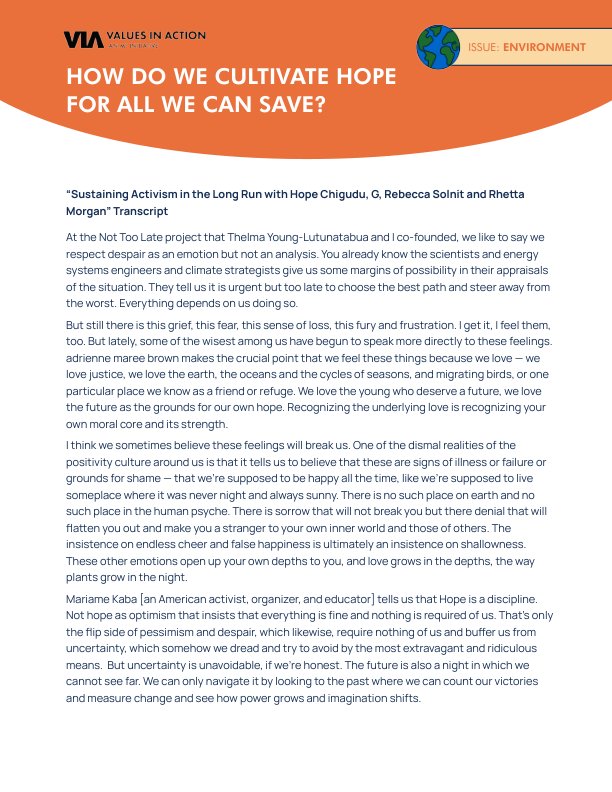
| Scan the QR Code or click here to watch a few minutes (minutes 3:00-6:36) from “Sustaining Activism in the Long Run with Hope" - Chigudu, G, Rebecca Solnit and Rhetta Morgan on the 350.org YouTube channel
|  |
| Print transcript if visual learners in the room would find it helpful. A full transcript can be found by scanning this QR code or at this link. |  |
Facilitator prompts group discussion (select 2-3 if time is limited):
WHAT DOES HOPE LOOK LIKE FOR YOU?
Facilitator prompts the group:
Facilitator read out loud:
In the exploration we just experienced we thought about how to remain hopeful in a climate-changing world. We listened to a talk by Rebecca Solnit on balancing idealism and realism as a way to engage with the tensions that surface.
Later in the same Rebecca Solnit talk, she says:
I want to leave you with a reminder that we already live in an impossible world. Only a few decades ago, a world powered by renewables [solar, wind, etc] was impossible. These were weak, inefficient technologies then, but we are at the inception of an energy revolution far greater than the Industrial Revolution and its steam power. Go back further and women having the vote or slavery ending were wild far-fetched things whose advocates were told they were naive dreamers of impossible things. … Unimaginable is not impossible. Looking back, we can see how stubborn idealism built the best parts of the world we are in now.
Both idealism and realism can help us face climate realities and take action at the scale that this challenge demands. Thinking about hope more deeply allows for active engagement, either stemming from the real world we see or the ideal one we imagine.
Facilitator prompts the group:
Facilitator read out loud:
In the exploration we just experienced we thought about how to remain hopeful in a climate-changing world. We listened to a talk by Rebecca Solnit on balancing idealism and realism as a way to engage with the tensions that surface.
Later in the same Rebecca Solnit talk, she says:
I want to leave you with a reminder that we already live in an impossible world. Only a few decades ago, a world powered by renewables [solar, wind, etc] was impossible. These were weak, inefficient technologies then, but we are at the inception of an energy revolution far greater than the Industrial Revolution and its steam power. Go back further and women having the vote or slavery ending were wild far-fetched things whose advocates were told they were naive dreamers of impossible things. … Unimaginable is not impossible. Looking back, we can see how stubborn idealism built the best parts of the world we are in now.
Both idealism and realism can help us face climate realities and take action at the scale that this challenge demands. Thinking about hope more deeply allows for active engagement, either stemming from the real world we see or the ideal one we imagine.
Facilitator prompts the group: