Home » Resource hub » How do I live in line with what the planet can provide?

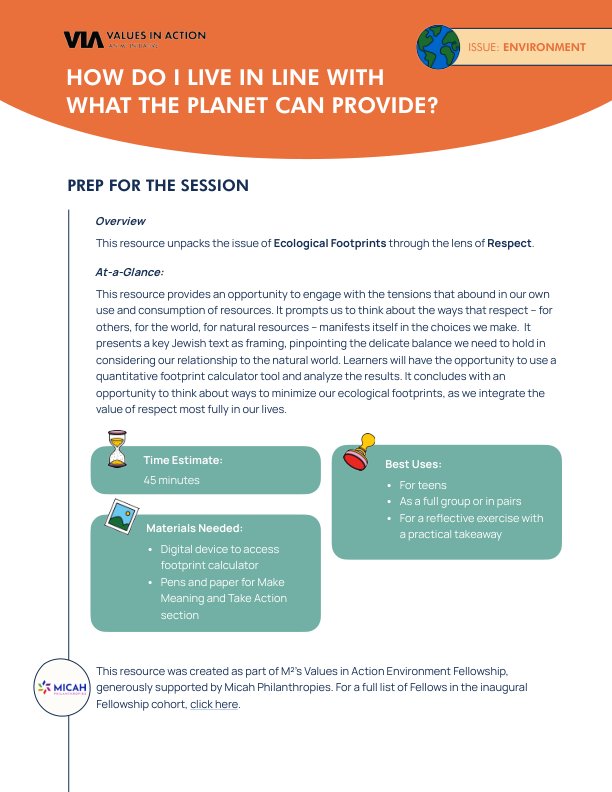
This resource provides an opportunity to engage with the tensions that abound in our own use and consumption of resources. It prompts us to think about the ways that respect – for others, for the world, for natural resources – manifests itself in the choices we make. It presents a key Jewish text as framing, pinpointing the delicate balance we need to hold in considering our relationship to the natural world. Learners will have the opportunity to use a quantitative footprint calculator tool and analyze the results. It concludes with an opportunity to think about ways to minimize our ecological footprints, as we integrate the value of respect most fully in our lives.
Read the following for context:
The world's natural resources are being depleted at an alarming rate, faster than they can replenish themselves. According to the UN's most recent Global Resources Outlook, resource extraction has more than tripled since 1970, including a fivefold increase in the use of non-metallic minerals and a 45 per cent increase in fossil fuel use.
Facilitator prompts the group:
Some questions to consider when looking at our living patterns and how we use the world’s resources include (these are thought questions, not to answer them now):
Through the exploration below we will have the chance to consider these tensions and how they play out in our own lives and the choices we make.
Facilitator prompts the group:
Engage with the value by reading the following:
Looking at this issue through the value of respect can offer a point of entry to think about the choices we make.
Respect in this context can be defined as honor and care shown towards someone or something that is considered important. The value of respect has many applications — to oneself, to another person (whether known or a stranger), to living things, to property, to the natural world, to tangible and abstract ideas, to all.
Facilitator prompts the group:
Jewish tradition emphasizes the central importance of respecting, protecting and preserving the world’s resources. This ethical principle, known as Bal Tashchit– “Do not destroy or waste” - directly relates to our urgent ecological challenges, ongoing climate degradation, and humans’ undeniable impact on the environment.
Read the following two pesukim/verses and answer the prompts that follow:
The Torah in Devarim/Deuteronomy 20:19-20 teaches:
"When in your war against a city you have to besiege it a long time in order to capture it, you must not destroy its trees, wielding the ax against them. You may eat of them, but you must not cut them down. Are trees of the field human to withdraw before you into the besieged city? // Only trees that you know do not yield food may be destroyed; you may cut them down for constructing siegeworks against the city that is waging war on you, until it has been reduced.”
— Deuteronomy 20:19-20
Facilitator prompts the group:
Read the following:
This Biblical commandment is central to ecology and environmentalism. It teaches that respect must lie at the heart of our relationship with the natural world and warns against needless destruction and waste.
The commandment calls us to be mindful of the critical role that plants, natural resources, and ecosystems play in sustaining human life. We depend on them for food, infrastructure, health, and survival itself.
At the same time, it recognizes the complexity of human need. We are permitted to use the world’s resources to meet our needs, but not excessively. Determining where that line lies is often difficult and deeply subjective. Yet healthy ecosystems provide essential benefits that cannot easily be replaced.
Facilitator prompts the group:
How many Earths?
Read the following:
Now, let’s dive into specific ecological footprints: How many earths are required to support each of our individual lifestyles? We are going to use a quantitative footprint calculator tool to estimate our energy, resource and land use, as well as what is needed to account for the waste and emissions that our consumption patterns produce.
 | Scan the QR Code or click this link to open the Global Footprint Network Calculator and answer the series of questions as they relate to your specific lifestyle. |
Prompt for individuals:
Prompts for small groups:
Read the following:
Knowledge is power.
Calculating our ecological footprints is not meant to shame anyone, nor put all (or even the majority) of the onus on you, as one person, to make shifts and thereby somehow “solve” the climate crisis. Industries and governments must enact sweeping reforms to safeguard people and planet, and we have to continue to hold them accountable for the consequences of their action and inaction! But being aware of our own ecological footprints is an important starting point from which we can better advocate for and affect change.
Reducing individual and collective footprints has measurable, wide-ranging, positive impacts on the planet and people who live upon it. By taking clear steps to conserve natural resources, reduce waste and pollution, and protect species and ecosystems worldwide, we are practicing respect for humans, living things and the Earth itself, so it can be sustained for us and future generations.
Facilitator prompts the group:
In the exploration we just experienced, we took a contemporary issue – ecological footprints and consumption – and explored it through the value of respect. Doing so offers us a way to think about what drives the ecological choices we make, and to recognize the competing desires on both sides of the choice spectrum. Today's conversation provided a chance for us to explore how being aware of our own ecological footprints can be an important starting point from which we can better advocate for and affect global change, even when it’s hard and we might otherwise desire different choices.
Go around the room and ask everyone who wants to share a reaction to one of the following prompts:
In the exploration we just experienced, we took a contemporary issue – ecological footprints and consumption – and explored it through the value of respect. Doing so offers us a way to think about what drives the ecological choices we make, and to recognize the competing desires on both sides of the choice spectrum. Today’s conversation provided a chance for us to explore how being aware of our own ecological footprints can be an important starting point from which we can better advocate for and affect global change, even when it’s hard and we might otherwise desire different choices.
Go around the room and ask everyone who wants to share a reaction to one of the following prompts: