This resource provides participants with an opportunity to deeply consider the environmental impacts of their clothing choices. It introduces the ecological implications of fast fashion and encourages participants to grapple with how their desires for self-expression may at times bein conflict with their other value systems. The Jewish value of bal tashchit, avoiding unnecessary waste, provides a spiritual foundation for exploring conscious consumerism. Learners will engage in an activity that identifies the values driving their personal clothing choices. Individual reflection and group discussion offer opportunities for considering how to align multiple values through the clothing that we wear.
Through our clothing, we present ourselves to the world. What we wear expresses both who we are and how we wish to be seen.
Today, we have more clothing options available to us than ever before. With the rise of “fast fashion” in the last few decades, which involves the rapid design,production, marketing, and distribution of clothing, consumers now have access to tremendous product variety at staggeringly low prices.
![]() |
Read the passage below and/or show this 6-minute video on the environmental impact of fast fashion by the Economist. |
Between 2000 and 2014, global clothing production doubled, demonstrating the spectacular growth of the fashion industry. However, while consumers bought 60% more clothing in 2014 than they did in 2000, they only keep the clothes for half as long (McKinsey and Company, 2016).
While this accessible abundance enables us to acquire the latest trends more easily, all this choice comes with a significant environmental price tag. According to the UN Environment Programme (UNEP), the fast fashion industry, marketed towards young consumers in particular, is the second-biggest consumer of water and is responsible for about 10% of global carbon emissions – more than all international flights and maritime shipping combined. Over 85% of all textiles go to the landfill each year, and the equivalent of one garbage truck full of clothes is burned or dumped in landfill every second(UNEP, 2018 and UNECE, 2018).
Facilitator prompts the group:
Consider for yourself, (but not to answer together as a group), how much or little should ecological considerations guide our clothing choices?
Facilitator prompts the group to engage in the following exercise:
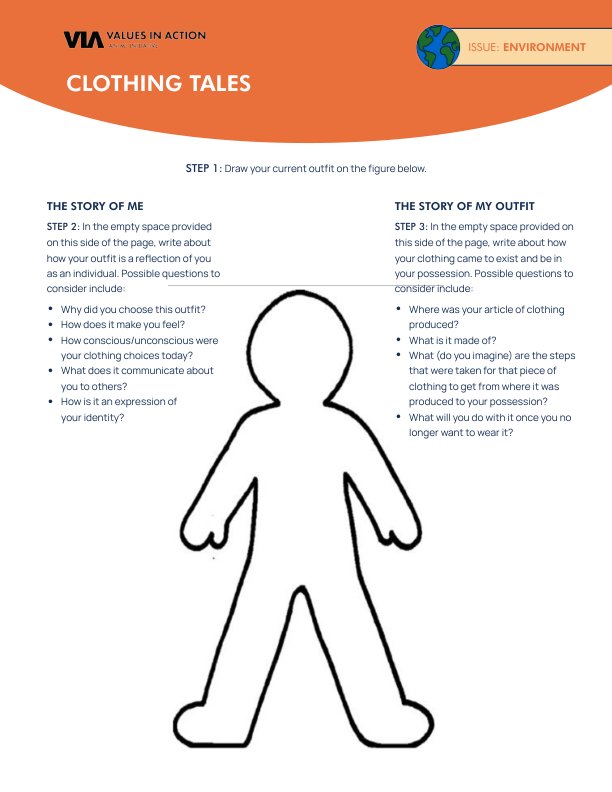
INDIVIDUAL ACTIVITY: CLOTHING TALES (10 minutes)
Scan the QR Code or click this link to to access the template for participants.
|
![]() |
Possible questions to consider, include:
3. On the right-hand side of the page (under the header, “The Story of My Outfit”), in the empty space surrounding the picture, ask participants to write about how their clothing came to exist and be in their possession.
PARTNER DEBRIEF (5-10 minutes)
In pairs, ask participants to reflect on the ways in which the two sides of their drawing are in alignment and the ways in which there may be disconnects.
Possible questions to consider, include:
GROUP DISCUSSION (10-15 minutes)
Share with the group the ad that Patagonia ran in 2011 in the New York Times on Black Friday, that read, “Don’t Buy This Jacket.” The ad can be accessed here.
Read this paragraph taken from their website about Patagonia’s decision to run their Don’t Buy This Jacket Campaign:
To lighten our environmental footprint, everyone needs to consume less. Businesses need to make fewer things but of higher quality. Customers need to think twice before they buy. Why? Everything we make takes something from the planet we can’t give back. Each piece of Patagonia clothing,whether or not it’s organic or uses recycled materials, emits several times its weight in greenhouse gases, generates at least another half garment’s worth of scrap, and draws down copious amounts of freshwater now growing scarce everywhere on the planet.
Encourage group discussion by asking the following questions:
Ground the group discussion in Jewish values by sharing the following teachings and discussion questions:
Bal tashchit is the Hebrew term for “do not destroy” and prohibits unnecessarily destroying or disposing of useful things. Although the Torah specifically mentions the senseless destruction of fruit trees (Dvarim/Deuteronomy 20:19-20), the Rabbis understood the prohibition to include other types of senseless waste, including clothing:
Whoever breaks vessels, or tears garments, or destroys a building, or clogs awell, or does away with food in a destructive manner violates the negative mitzvah of bal tashchit.
— Rambam, Hilkhot Melakhim 6:10
Facilitator prompts the group:
Continue reading:
One of the most effective ways of avoiding waste is to reduce the amount of clothing acquired to begin with. Similarly to the Patagonia add which invites us to reconsider what we “need,” the rabbis of the Talmud encourage us to find contentment with what we have:
Ben Zoma says:
Who is rich?
One who is content with one’s portion...
— Babylonian Talmud, Pirkei Avot 4:1
Facilitator prompts the group:
Continue reading:
Both of these sources above prompt us to think about waste, needs and satisfaction when it comes to our possessions (and can be extended to our clothing purchasing habits), encouraging us, perhaps, to “buy less."
But is there another side to thinking about our clothing choices? How might they represent our own self-expression and identities? Things we represent besides for ourselves?
The torah in Parashat Tetzaveh describes the sacred garments which the Kohanim, and Kohen Gadol– Priests and High Priest – wore for “glory and splendor” when they served in the Mishkan/the Tabernacle. These garments were made with fine fabrics, gold and jewels, and were visually quite beautiful. In ways, they may have been a bit “excessive” and sit in tension with some of the values we raised above. Why do you think they were still considered“sacred garments”?
Facilitator prompts the group:
Read the following:
| Climate activist, Sarah Lazarovic, created a “buyearchy of needs” to help guide our decision-making when we are faced with the question of “needing” stuff. Show the following poster to participants. Click here to access it. |

![]() |
Facilitator prompts the group:
Consider taking one of the following actions. As you review the list, write down which one you will take.
Facilitator encourages sharing of one action participants to committedto taking.

In the exploration we just experienced, we took an issue that is far-reaching in our world today – conscious consumerism and environmental waste – and explored it through the value of self-expression. Through that lens we are able to assess the ecological implications of fast fashion, and how it fits into the clothing choices we make. We had the chance to reflect on the balance of values we hold, and how we get dressed each day fits into it.
Facilitator prompts the group:
In the exploration we just experienced, we took an issue that is far-reaching in our world today – conscious consumerism and environmental waste – and explored it through the value of self-expression. Through that lens we are able to assess the ecological implications of fast fashion, and how it fits into the clothing choices we make. We had the chance to reflect on the balance of values we hold, and how we get dressed each day fits into it.
Facilitator prompts the group:
Pop Up that come after 2 clicks on page just for one time in coockes session