Session Objective
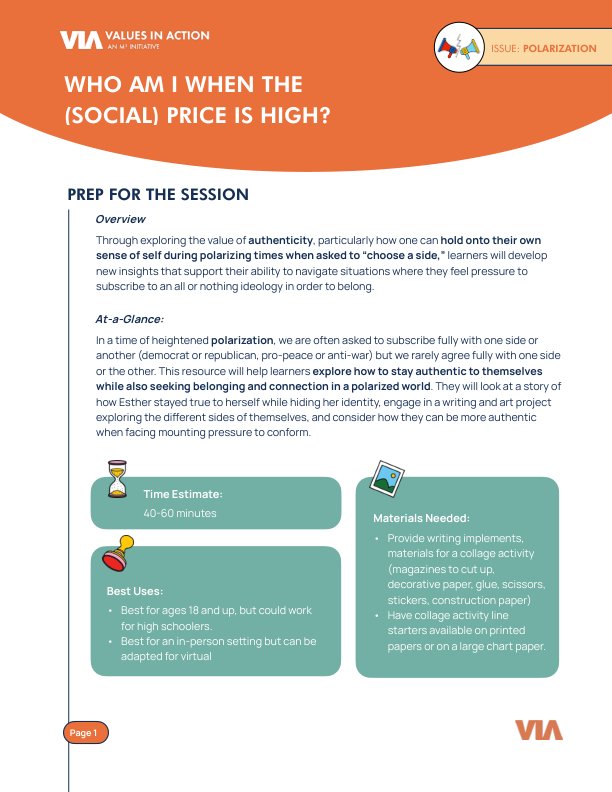
Through exploring the value of authenticity, particularly how one can hold onto their own sense of self during polarizing times when asked to “choose a side,” learners will develop new insights that support their ability to navigate situations where they feel pressure to subscribe to an all or nothing ideology in order to belong.
At-a-Glance:
In a time of heightened polarization, we are often asked to subscribe fully with one side or another (Democrat or Republican, pro-peace or anti-war) but we rarely agree fully with one side or the other. This resource will help learners explore how to stay authentic to themselves while also seeking belonging and connection in a polarized world. They will look at a story of how Esther stayed true to herself while hiding her identity, engage in a writing and art project exploring the different sides of themselves, and consider how they can be more authentic when facing mounting pressure to conform.
Have you ever said you liked something when you actually didn’t? For example maybe you said you liked a tv show, a musician, or even a type of food that you actually did not care for. What was the situation? How did that feel? What, if anything, happened as a result?
We’ve all probably done something uncomfortable just to feel accepted by others. Maybe you pretended to enjoy a hobby your friends were into, laughed at a joke you didn’t really think was funny, or posted something online that didn’t totally feel like you. Or maybe you ate the dinner your new friend made you even though you really don’t like kale.
Now, let’s raise the stakes: When, if ever, have you (or a friend/family member) ever felt like you needed to believe a certain thing or support a certain cause as “price for admission” into a group? Or heard a story of someone else being in that position?
It’s human nature to seek belonging in community with others, and yet it can sometimes feel difficult to find a community where you can be authentic and express all parts of yourself - especially as we are living in polarizing times. So often we feel pressure to pick a side (democrat or republican; feminist or anti-feminist; pro-peace or pro-war; or even pro-drinking-alcohol or against-drinking-alcohol) and feel pressure to conceal everything about ourselves that does not align with that side.
Possible responses: Your new group of friends frequently talk about how much they hate a certain musician, and you haven’t figured out how to tell them that you love that musician; you want to join the feminist club at school but it has not been welcoming to supporters of Israel.
Facilitator prompts the group:
In the Book of Esther, which takes place in ancient Persia, we recount the origins of the Purim holiday. Queen Esther of the Purim story faced a situation where she decided to hide a part of herself. When Esther went to the palace to try out for the position of queen, her cousin Mordechai advised her to keep her Jewish identity hidden because he believed it would make it more likely she would become queen. And she continued hiding her identity even after she became queen.
According to the rabbis, even while living in the Persian palace, Esther quietly stayed connected to her Jewish identity. The Midrash teaches that she ate only seeds and fruit so she could keep kosher.
Then, after she learned from Mordechai about Haman’s plot to kill the Jews, she had the courage to tell the king that she was Jewish and that Haman was planning to kill her people. In revealing her Jewish identity, she persuaded the king to stop Haman’s plan and save the Jewish people.
Facilitator prompts the group:
We are full of contradictions and polarities. We hold many identities, experiences, interests, aspirations and fears. We sometimes hold two (or more!) contradictory perspectives at once.
Consider a battery - it has two poles that help it to power a machine. If it only had a positive pole or only a negative poll, it would no longer work. So too, we need to attune to the polarities, contradictions, and opposing perspectives within us in order to be authentic to ourselves.
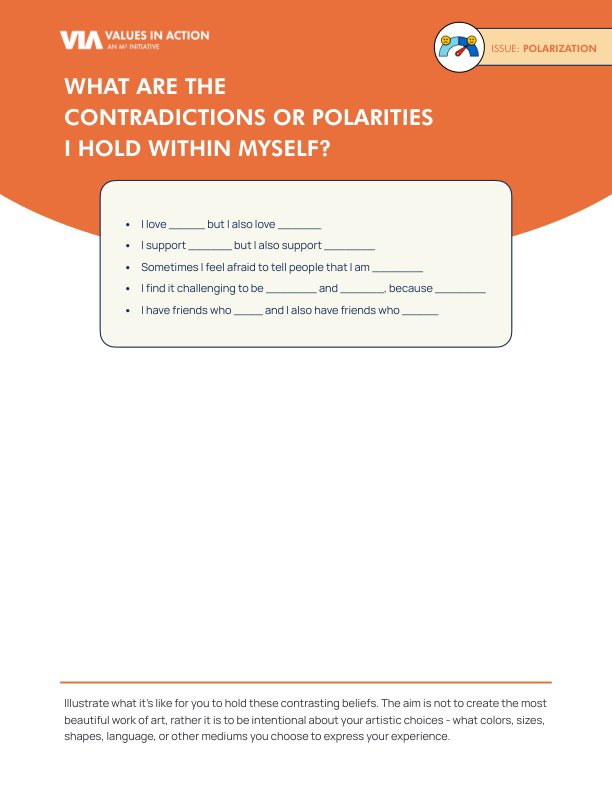
This next activity will invite you to explore the different sides of you. Consider this question: What are the contradictions or polarities I hold within myself?
To begin to process what this is, we’ll each journal our responses to these prompts:
We’re now going to illustrate these contradictions we hold within ourselves on paper. The aim is to be intentional about your illustration. What paper sizes, colors, shapes, tools like scissors or hands for ripping, and so on, can best illustrate what it’s like for you to hold these contrasting beliefs/ perspectives within you.
Invite learners to share what they created with one other person, or in a small group:
Our contradictions, while they might feel confusing or challenging, are one of the things that make us who we are, and give us power. Being authentic may mean holding on to these contradictions where possible, but there are also times when you may need to pick a side (voting in an election, affiliating with a specific group).
Facilitator prompts the group:
Revisit the situation you thought of earlier in the conversation.
Thank everyone for bravely bringing many parts of themselves to the gathering. Share a closing reflection:
Like the moon is still whole even when we can only see a sliver, may we honor all the parts and poles of ourselves - even the ones we choose to hold back. May we accept the fullness of our authentic selves wherever we go.
Pop Up that come after 2 clicks on page just for one time in coockes session