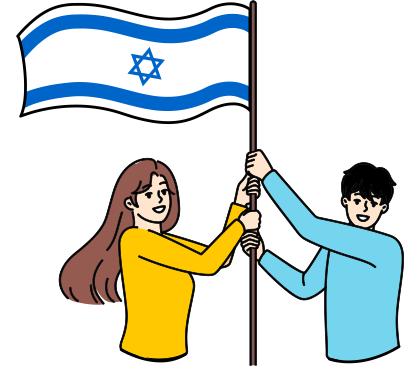
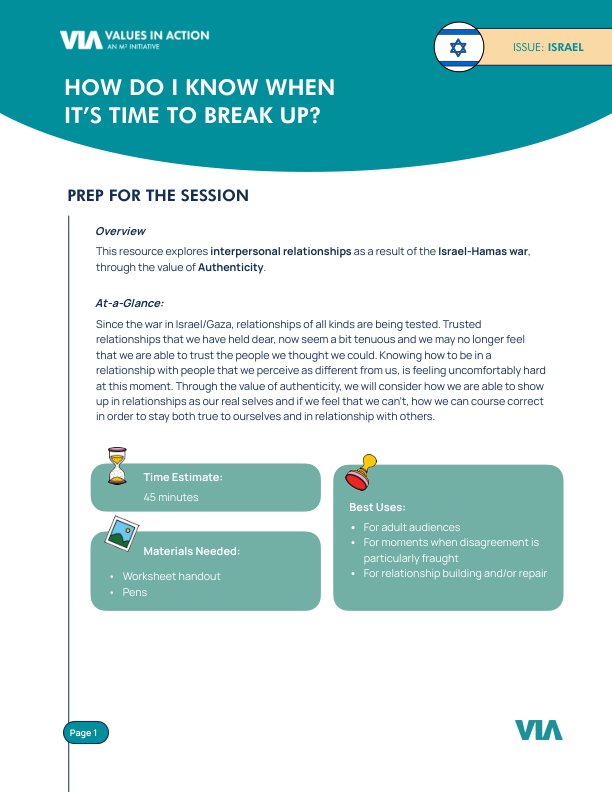
This resource explores interpersonal relationships during moments of tension or disagreement about Israel, through the value of Authenticity.
At-a-Glance:
In times of heightened emotion or disagreement about Israel, relationships of all kinds can feel tested. Trusted connections may suddenly feel tenuous, and we may question whether we can rely on people we once felt aligned with. Navigating relationships with people we perceive as different from us can feel uncomfortably hard. Through the value of authenticity, we will explore how to show up as our real selves, and when that feels difficult, how we can course correct in order to remain both true to ourselves and in meaningful relationship with others.
Facilitator reads for framing:
During periods of conflict, tension, or intense public discourse about Israel, the world can feel emotionally overwhelming. Social media often amplifies strong reactions, and the rhetoric in public spaces can feel inflamed. Trusted relationships may suddenly feel fragile, and we may no longer feel that we can trust people we once relied on. Being in relationship with people we perceive as different from us can feel particularly challenging.
Facilitator prompts the group:
Facilitator reads for framing:
Exploring these questions through the value of authenticity can offer layering to the many relationships that are tested through holding diverse viewpoints.
Authenticity is often described as the quality of being real or true to oneself and acting in accordance with desires, motives, ideals or beliefs that express who you really are. As our world continues to shift and we navigate periods filled with contradictions and uncertainty, some of the truths we once held may feel shaken. At the same time, new understandings can emerge, and many of us find ourselves discovering evolving layers of our authentic selves. All of this shapes the boundaries we set within our relationships.
Being in relationships requires us to make a collection of choices every day. It is about the choice to show up and be real - the choice to be honest to let our true selves be seen.
Facilitator prompts the group:
• As you think about this definition of authenticity, describe a moment within the last few weeks/months that you have felt like you can show your true self. What did it feel like?
THE FOUR HORSEMEN:
Facilitator reads for framing:
Often, crisis events force us to confront our convictions, and through introspection we claim our personal truths. When it comes to sharing them with others, though, we can hold ourselves back from giving those ideas life.
In 1983, Dr. John Gottman of the Gottman Institute designed a “love lab” where he observed how couples interacted and approached conflict. During his study, Gottman separated all couples into two groups: He called one group the masters of relationships; the other group was the disasters. The disasters of relationships had four behaviors in common, and he labeled these the Four Horsemen of the Apocalypse.
Dr. Gottman conducted additional research where he predicted break-up with 90% accuracy based on the first three minutes of a conversation. What he noticed was that couples who started their conflict conversation with criticism and elicited defensiveness in their partner ended up breaking up vs. couples who used gentle start-ups or began their conversation expressing their feelings and needs.
Facilitator prompts the group:
|
![]() |
Facilitator reads for framing:
In Jewish tradition, the Te’naim is an engagement ceremony created in 12th Century Europe.
During the celebration, the families signed a contract that was witnessed and read out loud to the community. This document set the date for the wedding and outlined the pre-marriage obligations of each family regarding the dowry, gifts, plus other financial and logistical matters. Although the contract wasn’t legally binding, like the ketubah (marriage contract), it was a symbolic way of recognizing what each person was committing to bringing to the relationship. And if either family went back on their word, there were consequences.
Today, some couples supplement the traditional Te’naim ceremony and articulate personal conditions and concerns — both current and future — that express their love, trust, shared values and commitment to the marriage.
Facilitator prompts the group:
Facilitator prompts:
Let’s take the Four Horsemen seriously.
Facilitator prompts the group:
Pop Up that come after 2 clicks on page just for one time in coockes session